
Choosing a backend technology is one of the most important early decisions a startup makes.
It affects development speed, hiring, infrastructure cost, scalability, and even how long the product survives before a rewrite becomes unavoidable.
PHP is often dismissed as “old” or “legacy” in startup circles, especially when compared to newer ecosystems like Node.js or Go.
However, the PHP of 2026 is not the PHP many founders remember from a decade ago.
This article provides a realistic, experience-driven analysis of whether PHP is still a good choice for startups in 2026.
It is written for founders, CTOs, and backend developers who want clarity, not hype, and who need to choose technology based on business reality rather than trends.
Why This Question Still Matters in 2026
Startups today operate under intense pressure:
- Limited engineering budgets
- Short runways
- High expectations for performance and reliability
- Constant iteration based on user feedback
In this environment, technology choices must optimize for speed, cost, and maintainability.
The question is not whether PHP is fashionable, but whether it helps a startup survive and grow.
Understanding the Modern PHP Landscape
Before evaluating PHP for startups, it is critical to separate outdated perceptions from current reality.
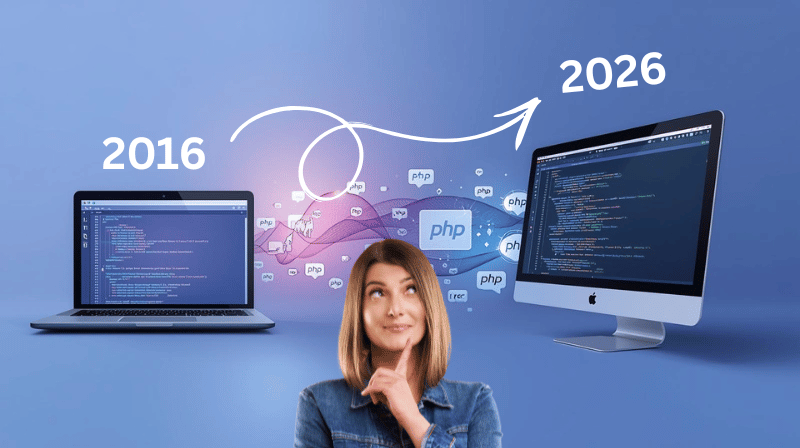
PHP has undergone fundamental changes since 2016, especially with the release of PHP 7 and PHP 8.
Modern PHP (8.2+) offers:
- Strong typing and predictable behavior
- Significant performance improvements
- Modern object-oriented features
- First-class tooling and dependency management
- Security improvements baked into the language
This means startups evaluating PHP in 2026 are not choosing a legacy scripting language.
They are choosing a mature, production-tested backend platform.
What Startups Actually Need from a Backend Language
To answer whether PHP is a good choice, we must first define what startups realistically need in their early and growth stages.
1. Fast Development and Iteration
Early-stage startups change requirements frequently.
Business models evolve, features are added or removed, and user feedback reshapes the product.
PHP excels in this area because:
- Low setup friction
- Fast request-response development model
- Mature frameworks and libraries
- Minimal boilerplate for common tasks
This allows small teams to ship features quickly without excessive architectural overhead.
2. Affordable Infrastructure
Infrastructure cost is often underestimated by early founders.
A backend stack that requires complex orchestration or long-running processes can become expensive very quickly.
PHP’s strengths here include:
- Excellent performance on modest servers
- Compatibility with affordable hosting options
- Strong performance even without heavy tuning
- Lower memory footprint for typical web workloads
For many startups, PHP can serve tens or hundreds of thousands of users on infrastructure that would be insufficient for other stacks.
3. Hiring and Talent Availability
Hiring is a practical constraint, not a theoretical one.
A technology stack that requires rare or expensive talent can slow growth or inflate burn rate.
PHP remains one of the most widely known backend languages globally.
- Large global developer pool
- Strong presence in emerging markets
- Lower onboarding time for junior developers
- Abundance of documentation and learning resources
For startups outside major tech hubs, this can be a decisive advantage.
Performance and Scalability: The Honest Truth
One of the most common concerns about PHP is scalability.
This concern is often based on outdated information.
How PHP Scales in Practice
Modern PHP applications scale horizontally very well.
Because PHP follows a stateless request model by default, scaling often involves adding more instances rather than redesigning the application.
With PHP 8:
- Request handling is significantly faster than older versions
- Opcode caching is mature and reliable
- JIT can improve CPU-heavy workloads
- Async patterns are available when needed
Many large-scale platforms still rely on PHP at their core, proving that the language itself is not a scalability bottleneck.
Where PHP Is a Strong Fit for Startups
PHP is particularly well-suited for startups building:
- SaaS products
- Content-driven platforms
- Marketplaces
- Internal dashboards and admin systems
- REST or JSON-based APIs
In these cases, PHP’s development speed and operational simplicity often outweigh the theoretical advantages of more complex stacks.
Where PHP May Not Be the Best Choice
A realistic analysis must also acknowledge PHP’s limitations.
PHP may not be ideal for startups whose core product depends on:
- Real-time systems with heavy persistent connections
- High-frequency trading or ultra-low-latency systems
- CPU-bound scientific computing
- Deeply concurrent, event-driven architectures
In such cases, languages like Go, Rust, or specialized platforms may be a better fit.
Long-Term Maintainability and Technical Debt
One of PHP’s historical weaknesses was the ease with which poorly structured code could be written.
Modern PHP addresses this through language features, but discipline is still required.
In 2026, PHP supports:
- Strict typing
- Immutable objects
- Clean architecture patterns
- Static analysis tools
Startups that adopt these practices early can build PHP systems that remain maintainable for many years.
Those that do not may still accumulate technical debt, just like with any other language.
PHP vs Trend-Driven Technology Choices
Many startups choose technology based on trends rather than requirements.
This often leads to:
- Overengineering
- Higher operational complexity
- Increased infrastructure costs
- Slower development cycles
PHP’s biggest advantage in 2026 is not that it is cutting-edge, but that it is stable, predictable, and well understood.
For most startups, these qualities are more valuable than novelty.
Final Verdict: Is PHP a Good Choice for Startups in 2026?
Yes, PHP is still a very good choice for startups in 2026, provided it is used with modern practices and realistic expectations.
PHP is especially suitable for startups that:
- Need to ship quickly
- Operate with limited budgets
- Want predictable infrastructure costs
- Value a large hiring pool
- Build traditional web or API-driven products
PHP is not a shortcut or a compromise.
It is a mature, battle-tested technology that aligns well with the real constraints most startups face.
Quick Decision Checklist
- Use PHP 8.2 or higher
- Enable strict typing from day one
- Adopt modern architecture patterns
- Use Composer and static analysis tools
- Avoid legacy PHP practices
FAQ
Is PHP outdated in 2026?
No. Modern PHP is actively maintained and widely used in production systems.
Can PHP handle startup-scale traffic?
Yes. PHP can handle significant traffic when properly configured and scaled.
Is PHP cheaper to run than other stacks?
In many cases, yes, especially for early-stage startups.
Will startups need to rewrite PHP later?
Only if poor architectural decisions are made. Modern PHP can scale long-term.
Is PHP suitable for APIs?
Yes. PHP works well for REST and JSON-based APIs.

Related items

APIs are the backbone of modern software systems. Whether you are building a startup produ
PHP has evolved more in the last ten years than it did in the two decades before that. Thi

Is your business growing? Do you need more than just a simple, static website? If you need