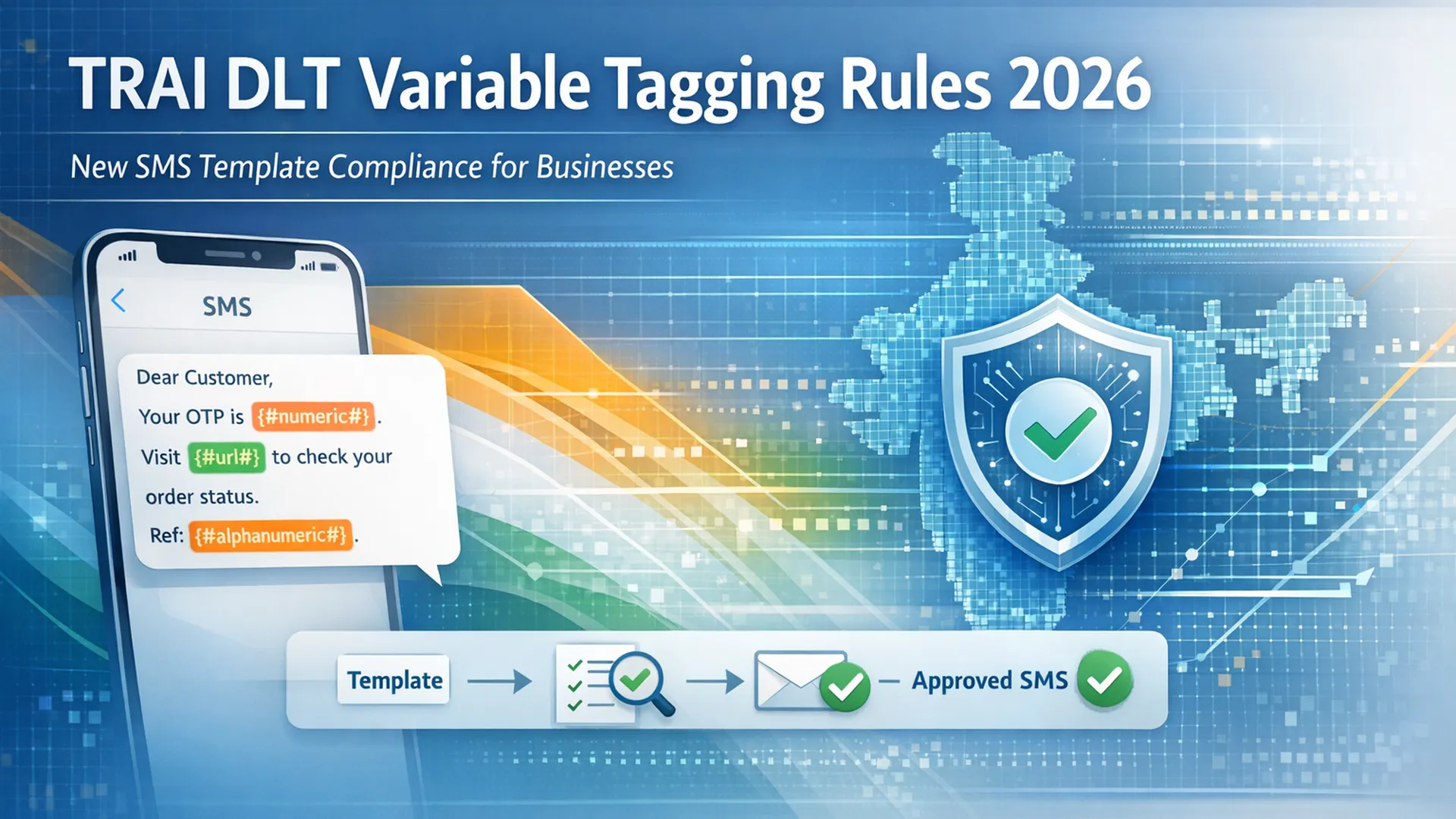
If your business sends OTPs, order confirmations, payment reminders, or promotional SMS in India, the TRAI DLT variable tagging rules 2026 directly affect you.
From 15 January 2026, SMS templates containing variables must be registered with clearly defined data-type tags. Templates without proper tagging may be rejected. Campaign traffic may be blocked.
This guide explains what changed, why it changed, how to comply, and what businesses must do to avoid disruption.
What Is the TRAI DLT Framework?
The Telecom Regulatory Authority of India (TRAI) is India’s telecom regulator. It introduced the Distributed Ledger Technology (DLT) framework to reduce spam and fraud in commercial messaging.
Under DLT:
-
Every sender must register as a Principal Entity.
-
Every SMS header must be approved.
-
Every content template must be pre-approved.
-
Only approved templates can be used for traffic submission.
The 2026 update strengthens validation at the variable level.
What Changed in 2026?
Mandatory Variable Tagging
Earlier, businesses used generic placeholders such as:
Now, every variable must be tagged using predefined data-type categories.
Example (New Format):
Only numeric values will be allowed in this placeholder.
Approved Variable Tags (As Per Direction)
| Tag | Allowed Data Type | Example Usage |
|---|---|---|
| {#numeric#} | Numbers only | OTP, amount, invoice number |
| {#alphanumeric#} | Letters + numbers | Order ID, ticket ID |
| {#url#} | Standard website link | https://example.com |
| {#urlott#} | App/OTT download link | Play Store link |
| {#cbn#} | Callback number | Support phone number |
| {#email#} | Email address | support@example.com |
Why Did TRAI Introduce Variable Tagging?
1. To Prevent Fraud
Fraudsters misused dynamic fields to insert phishing links or malicious content.
2. To Control Content Manipulation
Generic placeholders allowed businesses to change message meaning without reapproval.
3. To Strengthen Template Integrity
Tagged variables restrict data type misuse.
4. To Improve Consumer Trust
Consumers receive standardized and predictable SMS formats.
Before vs After: Clear Comparison
| Feature | Before 2026 | After 15 Jan 2026 |
|---|---|---|
| Variable format | Generic placeholder | Mandatory tagged placeholder |
| Data validation | Minimal | Strict data-type enforcement |
| Risk of misuse | High | Reduced |
| Template rejection rate | Moderate | Higher if non-compliant |
| Regulatory strictness | Medium | High |
Who Is Affected?
-
E-commerce platforms
-
Banks & NBFCs
-
EdTech companies
-
Healthcare providers
-
SaaS companies
-
Schools & ERP platforms
-
Bulk SMS resellers
-
Startups sending OTP
If you send transactional or promotional SMS via Jio DLT or any DLT provider, this applies.
Enforcement Timeline
Effective Date: 15 January 2026
All new templates must include tagged variables.
Existing templates will be reviewed later for scrubbing and modification.
Real-World Use Cases
OTP System
If your login system sends:
You must use:
Order Confirmation
Must use:
Payment Link SMS
Must use:
What Happens If You Ignore This?
-
Template rejection
-
SMS traffic blocking
-
Campaign failure
-
Compliance notices
-
Revenue disruption
DLT systems automatically validate data type at submission time.
Step-by-Step Compliance Guide
Step 1: Audit Existing Templates
Export all approved templates from DLT portal.
Step 2: Identify Variables
List every dynamic placeholder.
Step 3: Map Correct Tags
Match each variable to appropriate data type.
Step 4: Re-register Templates
Submit new compliant templates before 15 January 2026.
Step 5: Update Backend Logic
Ensure your SMS API sends only permitted data types.
Step 6: Train Campaign Team
Marketing and technical teams must understand tagging restrictions.
Common Rejection Reasons After 2026
-
Sending text inside {#numeric#} field
-
Using URL in alphanumeric field
-
Incorrect tagging category
-
Template text mismatch
-
Adding extra content beyond approved format
Frequently Asked Questions
What is variable tagging in DLT?
Variable tagging means labeling dynamic placeholders with predefined data-type identifiers to control content misuse.
Is tagging required for transactional SMS?
Yes. All SMS templates with variables must follow tagging rules.
Do existing templates need modification?
New templates must comply from January 2026. Updates for old templates will be announced.
Can I use custom tags?
No. Only approved tags are allowed.
Will this affect SMS delivery speed?
No. It affects validation, not delivery infrastructure.
People Also Ask
What is the penalty for non-compliant SMS templates?
Messages may be rejected or blocked. Persistent violation may invite regulatory scrutiny.
How does TRAI validate SMS content?
Through DLT validation engines that compare live traffic with approved templates.
Does this apply to WhatsApp?
No. This applies to SMS under telecom DLT regulation.
Actionable Compliance Checklist
-
Register as Principal Entity
-
Approve sender ID
-
Tag every variable correctly
-
Revalidate templates
-
Test traffic in staging
-
Maintain compliance documentation
-
Assign internal compliance owner
Internal Linking Suggestions
Use anchor texts such as:
-
DLT registration process guide
-
Bulk SMS compliance India
-
OTP delivery optimization
-
How to avoid SMS rejection
External Authority Linking Suggestions
Reference:
-
Telecom Regulatory Authority of India
-
Official DLT portal documentation
-
Telecom press releases
-
Government telecom notifications
Core Web Vitals Optimization Tips
-
Use compressed images
-
Add lazy loading
-
Use proper heading hierarchy
-
Optimize font loading
-
Reduce render-blocking scripts
Conclusion
The TRAI DLT variable tagging rules 2026 mark a major shift in India’s SMS compliance framework. Businesses must act before 15 January 2026 to prevent service disruption.
Strict tagging ensures cleaner telecom ecosystems, reduced fraud, and improved message authenticity.
Organizations that prepare early will experience zero downtime and uninterrupted campaign delivery.
If your business depends on OTP, transactional alerts, or marketing SMS, compliance is not optional – it is mandatory.
Start auditing your templates today.

Related items
Introduction Phone number login is now one of the fastest-growing authentication methods i

The Apple iPhone 18 Pro Max is expected to be one of the most refined smartphones Apple ha

Xiaomi’s Redmi Note series has always been popular. It offers: Strong features Affordable